Webb Images a Rocky World
18 September 2026
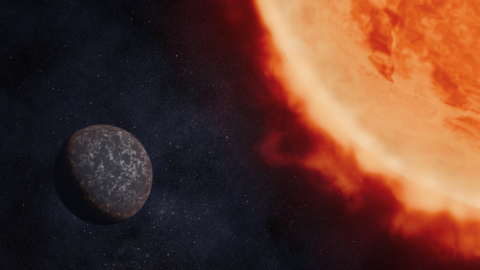
For most of exoplanet science, “seeing” a planet has meant something indirect — a dip in starlight as it crosses its sun, a wobble in a star’s motion, a smudge of atmosphere teased out of a spectrum. Actually reading the surface of a world tens of light-years away has always felt like a stretch too far. This year, the James Webb Space Telescope stretched that far anyway.
The target was LHS 3844 b, a super-Earth about 30% larger than our own planet, orbiting a cool red dwarf star roughly 50 light-years from Earth. It’s a world locked in a punishing routine: one full orbit takes just 11 hours, and it’s tidally locked, meaning the same hemisphere always faces its star while the other sits in permanent night. Astronomers first found it back in 2019, but until Webb, nobody could say much about what it was actually made of.
Webb’s Mid-Infrared Instrument (MIRI) changed that. As LHS 3844 b swept behind its star in a series of secondary eclipses, MIRI measured the infrared glow radiating off the planet’s scorched dayside — a temperature of around 725°C (1,340°F). Researchers then compared that thermal signature against a library of reference spectra from real rocks: samples and remote data from Earth, the Moon, and Mars. That comparison is what “directly studying the surface” means here — not a photograph, but a compositional fingerprint pulled out of heat.
The fingerprint ruled out anything resembling Earth’s granite-rich crust. Instead, it pointed to basalt: dark, dense, volcanic rock loaded with iron and magnesium, the same stuff that paves much of the Moon and Mercury. “We see a dark, hot, barren rock, devoid of any atmosphere,” said Laura Kreidberg of the Max Planck Institute for Astronomy, who led the study. Sebastian Zieba of the Center for Astrophysics at Harvard & Smithsonian added that the planet likely holds very little water. The findings appeared in Nature Astronomy on 2026-05-04.
It’s a bleak destination by any human measure — an airless, iron-dark furnace with no ocean and no sky. But it’s also a milestone: the moment an instrument built to study atmospheres light-years away turned out to be sharp enough to size up bare rock instead.
References
- James Webb Space Telescope directly studies an exoplanet’s surface for the 1st time — Space.com
- Webb space telescope reveals a scorching “super-Earth” that looks like Mercury — ScienceDaily
- Illustration of Exoplanet LHS 3844 b and Its Star — NASA Science (image source)