Roman Space Telescope Opens Its Eyes: Camera and Coronagraph Power Up
24 September 2026
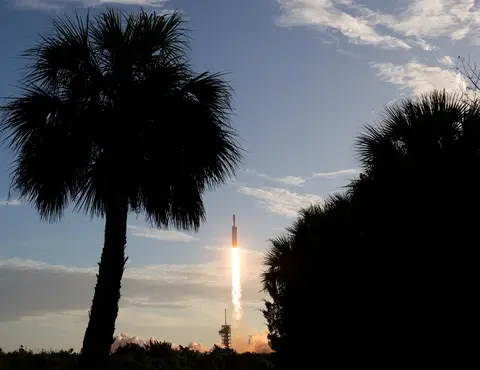
NASA’s newest space telescope just opened its eyes for the first time. The Nancy Grace Roman Space Telescope, which launched on 2026-08-30 aboard a SpaceX Falcon Heavy, has begun powering on its two primary instruments while it coasts toward its permanent home at Sun-Earth Lagrange Point 2 (L2), about 1.5 million kilometres from Earth.
The Coronagraph Instrument came online first, powering up on 2026-09-01. It’s a demonstration payload built to directly image exoplanets by physically blocking out a host star’s glare, using a set of shaped pupil masks, deformable mirrors, and precision optics. NASA says the goal is to eventually photograph giant planets that are older, colder, and orbiting closer to their stars than the young, hot super-Jupiters that direct-imaging missions have mostly captured so far. Engineers confirmed the whole optical chain is working and controllable from the ground, and they’re now running it through months of calibration.
The bigger of the two instruments, the Wide Field Instrument (WFI), began its activation sequence on 2026-09-11. It’s a 300-megapixel infrared camera built around 18 detectors covering an area roughly the size of a laptop screen — for comparison, a typical space telescope detector is closer to postage-stamp sized. That gives Roman a field of view about 100 times larger than Hubble’s per snapshot, while still matching Hubble’s image sharpness, since the two telescopes share the same 2.4-metre primary mirror size. To work, the WFI first had to be cooled in stages, from about -65°C down to roughly -183°C, before its detectors could be switched on. NASA confirmed first test photons on 2026-09-13 to 2026-09-14.
Once operational, the WFI is designed to do a lot at once: survey huge swaths of sky to map how dark energy and dark matter shape the distribution of galaxies, and run a broad census of exoplanets using a technique called microlensing, which can catch planets that transit and radial-velocity surveys tend to miss, including free-floating “rogue” planets not bound to any star.
Roman still has roughly 12 more weeks of cruising before it reaches L2, where it will join Webb in an orbit far from Earth’s heat and light interference. Both instruments will go through extended testing and calibration along the way, with NASA targeting early 2027 for the first released science images. The mission itself, led out of NASA’s Goddard Space Flight Center with hardware built by BAE Systems and Teledyne, notably launched nine months ahead of its original schedule and on budget — worth noting given how often big space telescopes run late. It’s designed to operate for at least five years, with enough fuel on board for a mission lasting up to 22 years (unverified exact fuel-derived lifespan figure, per NASA statements).
References
- NASA Activates Roman’s Primary Instrument, Checks Out Coronagraph
- NASA Roman’s Planet Imager Has Powered On
- Roman Space Telescope starts waking up as NASA powers on instruments for the 1st time — Space.com
- NASA just powered up Roman’s massive 300-megapixel camera — ScienceDaily
- Roman telescope deploys solar array and communication systems, powers on Coronagraph Instrument — NASASpaceFlight.com
- Nancy Grace Roman Space Telescope Launch — NASA Image and Video Library
- Image: NASA’s Nancy Grace Roman Space Telescope launches aboard a SpaceX Falcon Heavy rocket from Kennedy Space Center on 2026-08-30. Credit: NASA/Joel Kowsky