Light Sculpting
30 March 2026
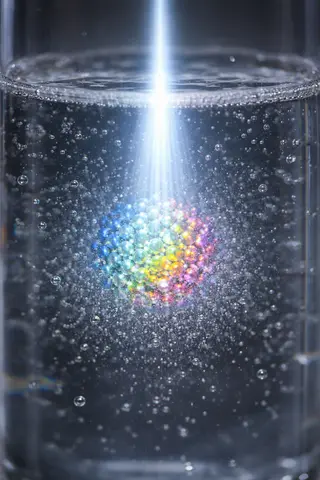
Light sculpting
Material science is an underappreciated discipline in modern research. Artificial intelligence and quantum computing capture headlines, but quiet revolutions are happening in laboratories all the time, where they study and manipulate how matter is organized. Without their advances our smartphones would remain bulky, medical implants would fail, and the transition to renewable energy would stall.
Researchers at New York University have now demonstrated a new tool in the material science toolkit. They have shown that light can serve as a remote control for crystal formation — a breakthrough that could transform how we build the materials of tomorrow.
The Challenge of Crystal Control
Traditional crystallization proceeds through thermal or chemical gradients that, once established, offer minimal flexibility for intervention.
The NYU team solved this problem by introducing light-sensitive molecules called photoacids into a liquid suspension containing colloidal particles — microscopic spheres typically measuring 1–1000 micrometres in diameter. When illuminated, these photoacids become more acidic, altering the surface charge of nearby particles. Photoacids are molecules that release protons when excited by light of specific wavelengths.
This change in charge can be used to alter the interactions between particles, switching their behaviour from repulsion to attraction or vice versa.
Light as a Sculpting Tool
The implications extend beyond starting or stopping crystal growth. The researchers demonstrated that light enables reversible operations: they could initiate crystallization, dissolve existing structures, reshape crystals in real time, and create more uniform and intricate colloidal assemblies than was previously possible.
This represents a fundamental shift from passive to active material control. Rather than setting the environmental variables and hoping for the desired outcome, this technique is more a part of the building process.
Applications on the Horizon
The research points toward several transformative applications:
Reconfigurable Optical Coatings: Colloidal crystals naturally produce structural colour—the same phenomenon responsible for the iridescence of opals and butterfly wings. By controlling crystal formation with light, engineers could develop coatings that change colour or transparency on demand. Such materials would find use in adaptive camouflage, dynamic signage, and tunable optical filters.
Next-Generation Displays: Current display technologies rely on emissive pixels or liquid crystal rotation. Light-programmable colloidal crystals offer an alternative paradigm: displays formed from physical nanostructures that reconfigure in milliseconds. These could achieve superior energy efficiency and viewing angles compared to existing technologies.
Adaptive Sensors: The sensitivity of colloidal crystal lattices to environmental conditions makes them excellent sensor platforms. Light-controlled assembly would enable sensors that reset or recalibrate optically, extending their operational lifetime and versatility.
Data Storage: The reversible nature of light-controlled crystallization suggests applications in optical data storage, where information could be written, erased, and rewritten through patterned illumination.
Advanced Communication and Computation: The NYU researchers specifically highlighted their technique as “a key step toward building advanced communication and computation technologies”. Programmable photonic crystals could serve as reconfigurable waveguides and optical switches essential for next-generation optical computing architectures.
The Broader Context
This work builds upon years of foundational research in colloidal self-assembly and programmable materials. The field has evolved from passive observation of particle aggregation to active, intelligent design using external stimuli including temperature, pH, electric fields, and now light.
Artificial intelligence is increasingly guiding these assembly processes, enabling optimization of complex multi-component systems.
What distinguishes the NYU achievement is the combination of simplicity, reversibility, and spatiotemporal control. The technique requires no specialized equipment beyond a light source and operates at ambient conditions. This accessibility may accelerate translation from laboratory curiosity to industrial application.
Material science contunues to develop ingenious ways of controlling our physical world. The ability to sculpt crystals with light promises applications and future developments we have yet to conceive of.