Commercialization of the Moon
31 March 2026
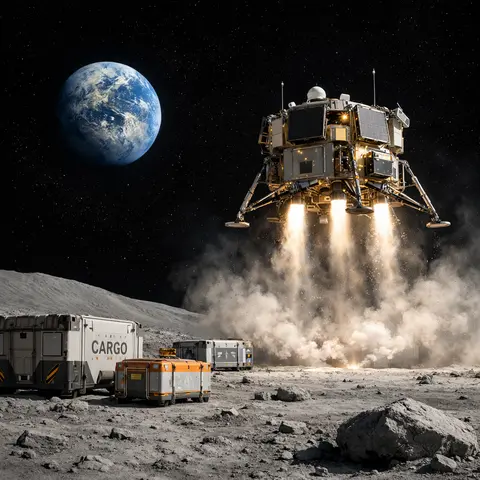
NASA’s Commercial Lunar Payload Services: Opening the Moon to Private Enterprise
Nasa has been purchasing end-to-end delivery services from commercial companies to deliver cargo and crew to the International Space Station.Their Commercial Lunar Payload Services (CLPS) program is now doing the same for getting cargo to the moon, and possibly future crewed missions.
How CLPS Works
Under CLPS, NASA contracts with private firms to transport scientific instruments, technology demonstrations, and exploration payloads to the lunar surface and orbit. The program operates on fixed-price contracts, meaning companies assume the financial risk while NASA gains cost predictability. With a combined maximum contract value of $2.6 billion through November 2028, the initiative has already awarded 11 lunar deliveries to five vendors, carrying more than 50 payloads.
The Leading Contenders
Among the 13 eligible companies in the CLPS pool, several stand out as likely early beneficiaries:
Firefly Aerospace has already demonstrated its capabilities. The Texas-based company’s Blue Ghost lander successfully touched down on the Moon on 2 March 2025, delivering 10 NASA payloads—the first fully successful CLPS mission. Firefly has a second mission scheduled, with its Blue Ghost Mission 2 on the launch manifest.
Intuitive Machines made history in February 2024 with the first American lunar landing in over 50 years, though its Odysseus lander tipped onto its side. Despite the imperfect landing, the Houston company proved the concept and remains a key player in the program.
Astrobotic Technology experienced a propulsion failure with its Peregrine lander in January 2024, but the Pittsburgh firm continues development of its larger Griffin lander, which will carry NASA’s VIPER rover to the lunar south pole.
Blue Origin received the high-profile VIPER rover contract in 2024, leveraging its substantial resources and experience with the New Glenn launch vehicle. The Kent, Washington company brings significant financial backing from Jeff Bezos, positioning it for sustained lunar operations.
Looking Ahead
NASA has ambitious plans for the program, targeting up to 30 robotic landings beginning in 2027. This accelerated cadence will support the broader Artemis campaign, with payloads scouting lunar resources, testing in situ resource utilization, and conducting science near the south pole—where future crewed missions are expected.
For space enthusiasts, CLPS represents a fundamental shift in lunar exploration. The Moon is no longer the exclusive domain of government programmes; it is becoming accessible to a growing ecosystem of commercial providers, each competing to deliver payloads faster and more economically than ever before.