Carbon Skies
31 March 2026
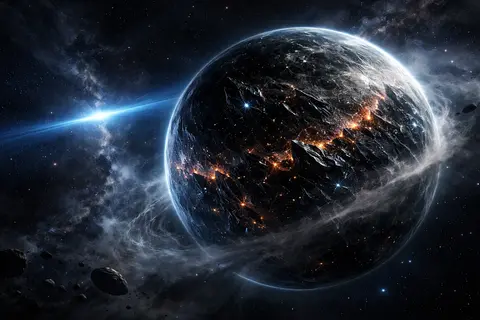
The Carbon Atmosphere: Webb Finds an Exoplanet That Breaks All the Rules
NASA’s James Webb Space Telescope has spotted something strange in the cosmos. A distant Jupiter-mass world called PSR J2322-2650b is rewriting what we thought we knew about planetary atmospheres.
An Atmosphere Like No Other
This exoplanet’s atmosphere is unlike anything ever catalogued. It is dominated by molecular carbon—specifically C₃ and C₂—with helium making up the rest. No oxygen. No nitrogen. Just carbon and helium in forms that should not exist at these temperatures.
That is the puzzle. At the scorching temperatures found here—ranging from 650°C on the night side to over 2,000°C on the day side—carbon should react with other elements. It should bind with oxygen or nitrogen if they are present. Yet neither shows up in Webb’s data. The carbon remains stubbornly uncombined.
Soot clouds likely drift through this alien air. Deep below, those carbon clouds may condense into diamonds.
Why This Matters
Scientists have studied roughly 150 exoplanet atmospheres. None look like this. PSR J2322-2650b represents an entirely new category of planetary atmosphere.
Current theories of planet formation cannot explain it. The usual recipes for cooking up a world do not produce this outcome. As one researcher noted, “Did this thing form like a normal planet? No, because the composition is entirely different”.
One hypothesis suggests the planet’s interior contains a mixture of carbon and oxygen that crystallizes as it cools. Pure carbon crystals might float upward and mix into the helium atmosphere. But something must keep oxygen and nitrogen at bay—and nobody knows what that is.
What Comes Next
This discovery opens more questions than answers. How did such an atmosphere form? What processes stripped away—or never included—the elements we consider normal?
Webb’s sensitivity made this find possible. Its instruments peered through the glare of the planet’s host star to decode the atmospheric chemistry. The telescope continues to deliver surprises that reshape our cosmic perspective.
Reading
NASA’s Webb Observes Exoplanet Whose Composition Defies Explanation - NASA Science