Interstellar Comet 3I/ATLAS Is Leaking Gas in Slow Motion — and Scientists Aren't Sure Why
6 October 2026
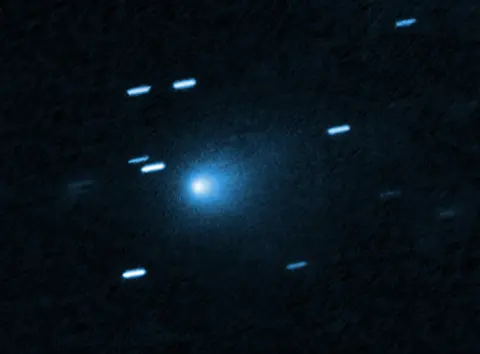
Comet 3I/ATLAS, only the third interstellar object ever confirmed passing through our solar system, keeps turning up surprises. The latest one: its gas isn’t escaping nearly as fast as it should be.
A team led by Anita Cochran of the University of Texas’s McDonald Observatory used the Hobby-Eberly Telescope and its VIRUS spectrograph to map gas around the comet’s nucleus out to more than 85,000 km away. The observations, taken on 2025-12-09 when the comet was 2.03 AU from the Sun and 1.83 AU from Earth, found the gas moving at only about half the speed typically seen in solar system comets at a comparable distance from the Sun. The results were published in the Planetary Science Journal (vol. 7, article 226) and reported by Sci.News on 2026-10-05.
That sluggish outflow is odd enough on its own, but the spectra turned up something else unusual: strong emission lines from neutral iron and nickel, which the team concludes are coming directly off the comet’s nucleus in metallic form. That’s notable because the comet’s surface, at its measured temperature, should be far too cold to vaporize iron or nickel outright — comets releasing metals like this is not something seen to this degree in ordinary solar system comets, and 3I/ATLAS’s iron and nickel signatures are stronger than those measured in either of the two previous confirmed interstellar visitors, 1I/‘Oumuamua and 2I/Borisov.
Cochran and her colleagues suggest the slow gas flow could be explained by heavier molecules, such as carbon dioxide, driving the outflow instead of the lighter water vapour that usually dominates cometary activity — or by icy grains lofted off the surface that then evaporate more gradually as they drift outward. Separately, a team led by Nicolas Biver using the IRAM 30-metre telescope in Spain reported similar sluggish gas velocities around the comet’s perihelion in October 2025, along with an atypical chemical mix — notably depleted hydrogen cyanide and an unusually low sulfur-to-carbon ratio compared with solar system comets. Two independent facilities, in other words, are seeing the same basic anomaly from different angles.
Why it matters: 3I/ATLAS formed around another star, long before our own solar system existed, so its chemistry is effectively a sample of material from somewhere else entirely. Figuring out why its gas behaves so differently from the comets we’re used to could reveal something about the conditions — temperature, radiation history, chemical makeup — of the planetary system it came from, or about what happened to it during its journey through interstellar space. As Cochran put it, the goal is to learn about “conditions in the natal planetary system of this target and/or its long interstellar journey.”
The comet is now outbound, having passed perihelion on 2025-10-30 at a safe distance of roughly 130 million miles from the Sun, posing no threat to Earth. It remains observable with large telescopes into 2026, so more data — and likely more surprises — should keep arriving as astronomers continue tracking it on its way back out of the solar system.
References
- Interstellar Comet 3I/ATLAS is Spewing Gas Surprisingly Slowly, New Observations Show — Sci.News
- IFU Observations of Comet 3I/ATLAS = C/2025 N1 (ATLAS) using the Hobby-Eberly Telescope with the VIRUS Instrument — arXiv
- Updates on Interstellar Comet 3I/ATLAS: New Images, Many Tails, and Non-gravitational Forces — Sky & Telescope
- Comet 3I/ATLAS Facts and FAQs — NASA Science
- 3I/ATLAS image — ESA/Hubble (credit: NASA, ESA, D. Jewitt (UCLA); image processing: J. DePasquale (STScI))